
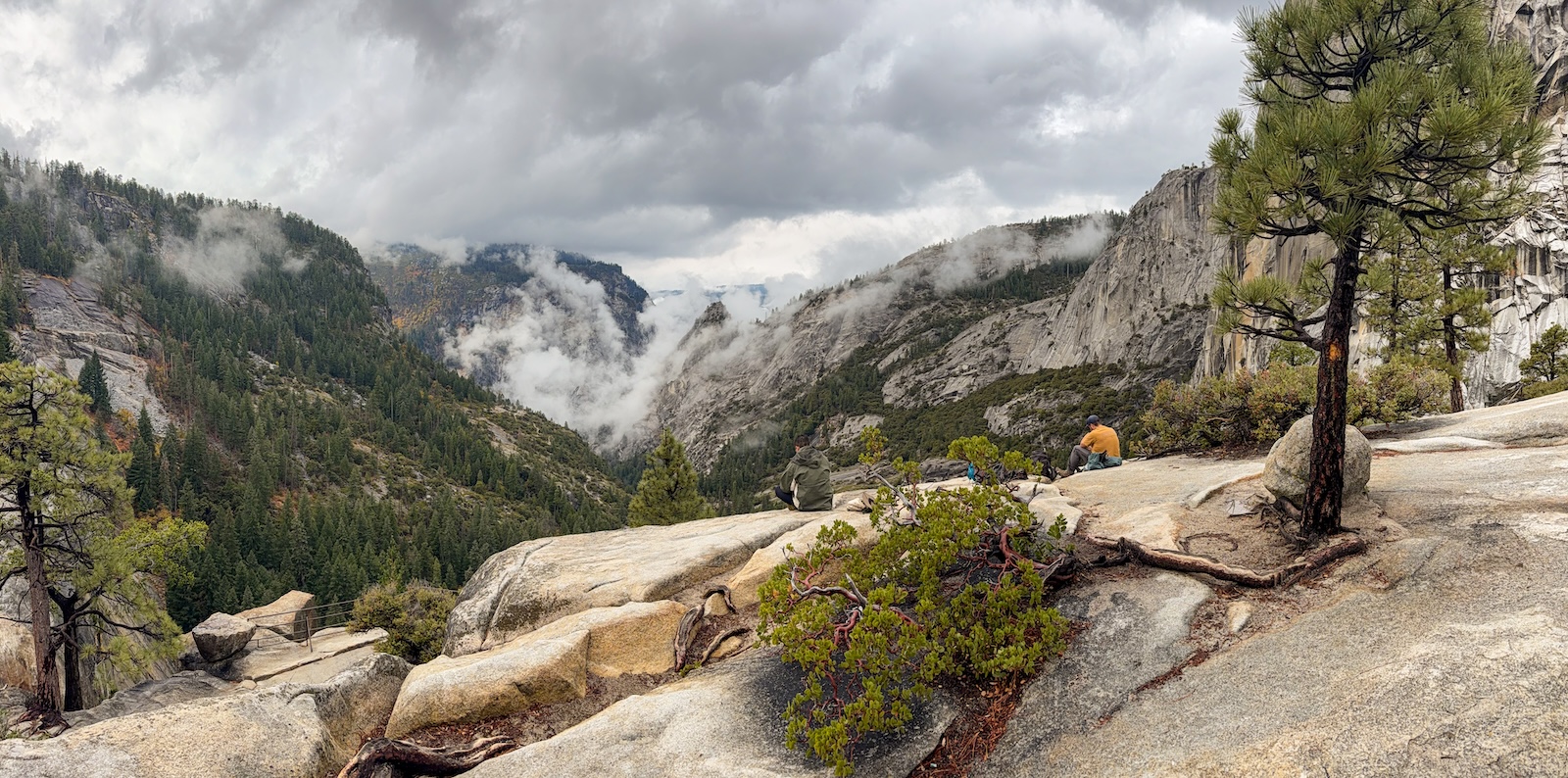
Healing in recovery can include periods when we feel small and insignificant. At the lower points of our addiction, we may cover ourselves to hide from a world beyond our control.
Yet there are places that make us feel small while inspiring us to reveal ourselves. Places where we become willing to step out from beneath the covering and into the warm light of recovery.
Yosemite was a place like that for me. It is immense and remarkable.
A photograph can show you the granite walls, the trees, and the sky. What’s harder to capture is the feeling of standing there, looking up—or looking out—and realizing how little of it will fit inside a frame. My panorama setting has never worked so hard!
Two days in Yosemite National Park included exploring nearly 20 miles on foot and gaining more than 4,000 feet in elevation. I didn’t try my hand at free climbing El Cap or Half Dome, but I did put myself through a test I wasn’t completely sure I could pass.
I’m happy to say that, despite my reservations, I not only survived but grew from the experience. While I’m proud of that, something else hit me square in the face and stayed with me after I left the park.
No, it wasn’t the nearly perfect granite face of an absurdly large mountain, nor was it the branches of a giant sequoia. It was the scale of the place.
I had the sense that I was standing in the middle of something much older and grander than me. My joints and bones creaked with every step, reminding me of my age. Even so, I knew I was just a baby compared to the landscape around me.
Between what I learned in the education center and the articles I’ve been consuming since my return, I kept coming back to two words: pressure and time.
Naturally, I was reminded of The Shawshank Redemption. Andy had plenty of pressure and time to make his chess pieces, along with an escape tunnel hidden behind a big damn poster of “Lovely Raquel.”
But there in Yosemite, I wasn’t trying to escape a metaphorical prison or create a new chess set. In many ways, I have already made much of that escape, and I don’t play much chess.
I was thinking about where I’ve been, how I’ve grown, and how pressure and time have played a role in my life. For years, I hid beneath the weight of my addiction, keeping people from seeing the real me. Then, with help from others in recovery, that covering began to recede. I began to recognize who I once was and discover who I am today.
Standing there, I could appreciate the beauty of something that had taken so long to take shape. Maybe I could extend some of that appreciation to my own life.
I came to Yosemite because all I had ever heard was how beautiful and unbelievable it was.
During my time there, I gained something else: perspective.
Hidden Beneath the Ice
Looking out across Yosemite, I tried to picture the landscape beneath the ice that once occupied it. I imagined the overwhelming weight, the tediously slow movement, and the fractured rock hidden from view.
That image stayed with me because addiction can feel like that.
We have lives before our drug of choice begins taking up so much room. We have personalities, interests, strengths, and possibilities we may not yet have discovered. There is beauty in us before we know how to recognize it.
But somewhere along the way, we begin to hide.
For some of us, our drug of choice offers relief from the feeling that we aren’t who we are supposed to be. It quiets the uncertainty. It makes a difficult situation tolerable or helps us play a part we don’t feel capable of playing on our own.
Over time, we disappear further into it. We seek to escape.
The substance takes up more space. The effort required to use it, conceal it, recover from it, and explain its consequences begins organizing our lives. Other parts of us get less attention.
Like a mountain beneath a glacier, we are still there. We may be broken, battered, and invisible, but we’re still there.
We’re covered.
Letting the Ice Recede
Recovery asks us to become willing to be seen. It doesn’t ask us to melt the ice, repair the rocks, or plant new trees. It just asks us to be willing to be seen as our authentic selves.
Don’t mistake this as something simple or easy. Exposing a self that has been hidden can be incredibly uncomfortable and even terrifying. There’s a reason it has been hidden for so long. We may have built entire routines around keeping people at a distance. Removing these protections requires very brave people doing very brave work, with a little help from something bigger than ourselves.
It means telling the truth when we would rather manage the impression. Listening when we want to explain. Admitting that our own attempts to control the situation have brought us somewhere we no longer want to be.
We begin letting go of the idea that we must personally design every detail of who we are supposed to become. We accept guidance. We allow room for a possibility beyond what we can currently imagine.
If you’re having trouble with this concept, a place like Yosemite Valley might offer a starting point. Standing there gave me all the evidence I needed to believe that there was something greater than myself at work—a power working over spans of time I can’t conceptualize, moving immeasurable amounts of earth, and creating beauty beyond imagination.
Once we acknowledge the help from something bigger than ourselves, we get to work.
We show up. We reach out. We examine our behavior and begin taking responsibility for it. We practice living without the covering we once depended on.
Over time, the ice recedes.
While there are certainly days when we feel exposed and wish we could hide again, we work to remain seen, or at least visible.
The truth is that we don’t need to know exactly what the landscape will look like when the ice recedes. We just have to trust that there is something beautiful beneath it.
What Emerges Is Beautiful
Thinking about the force of moving ice, it would be easy to imagine a landscape defined entirely by destruction.
Broken rock. Pieces carried away. Evidence of immense pressure and change. The visual manifestation of pain.
And yet, standing in Yosemite, I was surrounded by beauty.
That was the connection that stayed with me.
Knowing what addiction can do to a life, we may expect recovery to reveal only a war zone. We prepare to face the damage, the losses, and everything that needs repair.
There is real work waiting there. Some consequences take time to address. Some losses stay with us.
But then we begin to see the person.
Humor finds its way into a conversation. Someone becomes dependable again. A parent is present with their children. A friend answers the phone. A person who once felt they had nothing to offer sits beside someone newly sober and helps them feel less alone.
Strength becomes visible. Kindness has room to act. Interests return, or new ones develop.
We discover that the landscape holds far more than evidence of what went wrong.
Addiction covers so much of our beauty that we struggle to believe it’s still there. Through recovery, we begin to recognize it in ourselves again.
Often it’s those around us who see things first. They see someone worth knowing. Someone worth loving.
That person is there – waiting to be seen and appreciated.
A Masterpiece Can Be Unfinished
Calling what emerges a masterpiece may feel uncomfortable. I’ll be the first to acknowledge that my beauty is not nearly as impressive as a big gray rock. That said, there’s something in my landscape that has value.
I know my rough edges. I remember the things I regret. For sure, I can list the things I’m still working on much more easily than I can name anything I appreciate about myself.
But look at the photograph.
The cracks belong to the view. So do the uneven surfaces, the exposed rock, and the places where pieces have fallen away. You don’t need to erase them to appreciate what is there.
Those soft, off-white clouds, wrapping around the rough rock, remind me of the support we receive in recovery. They quietly envelop the landscape and hide the rock from view, almost providing reassurance or shelter from the rest of the world.
There is healing in this place, just like there is healing in recovery.
It’s completely acceptable to acknowledge the past and recognize present beauty. These may seem like opposing positions, but I find them complementary. We can make amends while accepting that we are worthy of connection. We can keep growing without treating ourselves as something that must remain hidden until every flaw has been corrected. We can be the artist bold enough to reveal our work before it’s perfect.
Recovery gives us the opportunity to live as someone we no longer need to conceal.
There is something magnificent about watching a person become comfortable enough to be honest, strong enough to accept help, and willing enough to begin again.
It’s even more magnificent to be that person.
A Different Perspective
When I left North Carolina to see Yosemite, I was bursting with excitement. This was a place I had long wanted to see with my own eyes. I had heard countless descriptions and been encouraged numerous times to see it for myself. I had been waiting to take this trip for much longer than the few months since I bought my plane ticket.
I expected to be impressed. I expected to feel awe.
What I didn’t expect was to find appreciation and validation.
It’s been more than three years since I started this journey, and some of those days have been better than others. There are times when my strength and confidence are challenged. Sometimes I even question whether I am on my own in this world.
My two days in Yosemite were not those days. They validated my belief in something bigger than myself. They encouraged me to climb higher than I might otherwise dare—and to expose parts of myself that can feel as bare as those gray walls towering over Yosemite Valley.
The experience helped me remember to acknowledge the person hidden beneath the addiction. There is remarkable beauty in that person, and sometimes it becomes so obscured that no one—not even the person living beneath it—can see it.
I am very aware of what help, willingness, and time can make visible.
When we look at ourselves, or at someone still struggling, we may see the ice first. It can occupy so much of the picture that we forget there is anything else to see. It is heavy, cold, and foreboding.
Recovery gives us a different perspective. As the ice recedes, we can become curious about who we once were and who we are today.
If we take the time to look, we may begin to appreciate what pressure and time have revealed. We may find a person who is still healing, still learning how to live—but capable of a life that inspires love, appreciation, and awe.
Standing in Yosemite, I had no difficulty recognizing a masterpiece.
I hope to remember that when I look for the beauty in the people doing the work of recovery.
At True North Sober Support, we recognize that recovery is personal and that people find strength through different beliefs, communities, and approaches. References to a Higher Power reflect the perspective shared in this article. You do not need to share those beliefs to deserve support, connection, and the opportunity to discover what recovery can reveal.

Be the first to comment